

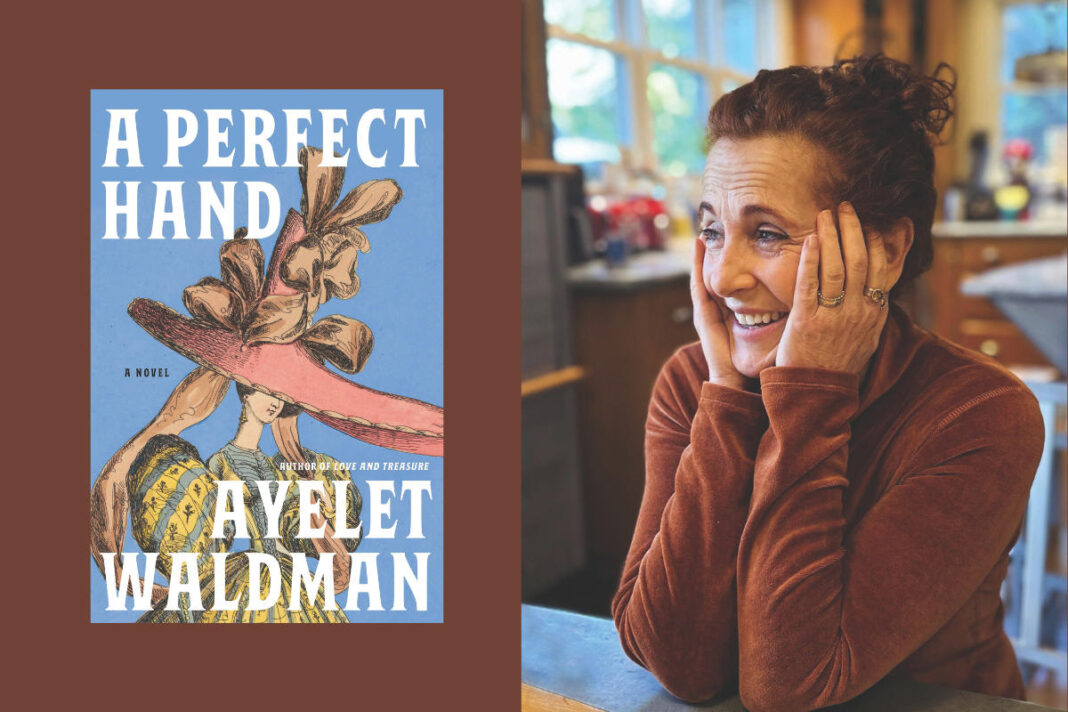
Berkeley-based author Ayelet Waldman is like the suffragettes and early 19th century feminists she came to admire while writing her new novel, A Perfect Hand (Knopf, 2026). A New York Times best-selling author, Waldman is clever, articulate and blessed with time, resources and determination. Importantly, she has access to multiple publishing outlets, from analog to digital, all designed for a career that encourages full expression of unusual insights.
Waldman is the author of novels, nonfiction books, the Mommy-Track Mystery series and a memoir/essay collection about modern motherhood that was sparked by a controversial article she wrote for The New York Times. She is co-creator of Netflix’s Unbelievable, for which she won or was nominated for several distinguished prizes and awards. A social rights activist, she is the co-editor of Inside This Place, Not of It: Narratives from Women’s Prisons and of Kingdom of Olives and Ash: Writers Confront the Occupation. Waldman is the mother of four adult children and married to novelist Michael Chabon.
A Perfect Hand is a brilliantly subtle contemporary novel set primarily in the 19th century. The book’s protagonist, Alice Lockey, is a lady’s maid in a Victorian household. Serving Lady Jemima Alderwick, Alice meets Charlie Wells, valet to Jemima’s supposed suitor, Viscount Nigel Wynstowe. The two servants fall in love and embark on a quest to pivot their aristocratic employers’ aversion to each other into a marriage. If their behind-the-scenes matchmaking is successful, it will ensure they’ll be together while working to build equity toward the future they imagine.
Cloaked in the vestiges, language, fashion, bodily care obsessions, near-eccentric preoccupations, and vast class and gender inequities of the era, Waldman’s Jane Austen-esque Victorian novel is laugh-out-loud funny, historically educational and a forceful declaration that words hold power.
In an interview, Waldman responds to the suggestion that her book’s fundamental assertion is that written words can change the course of history, people, society and human life. Without ever stating it in the novel, Alice’s eventual transformation from lady’s maid to women’s rights activist is word-reliant and leads directly to surprising, climatic scenes that come at the end of the novel.
“Words and reading matter? I’ve never articulated it that way, but I love that idea. Yes, hell yes,” Waldman says. “Writers don’t have anything in common other than they were all readers as children. Peculiarly, novels rarely have characters who read. I knew Alice would be a reader, but as her character took shape in my mind, that became an indelible part. Perfect Hand is almost a defense of reading. Sure, there are videos now, but most of the people using phones today are consumed with reading.”
Well-crafted writing about people and topics of substance is an obvious corollary. Establishing and maintaining characters’ voices, she notes, “is everything.” While wrestling Perfect Hand through early drafts, catching Alice’s and other characters’ voices was a cycle of search and struggle.
She recalls a previous book in which the protagonist’s voice “landed on my head like an anvil on a cartoon character” and another book when a character’s full profile flowed quickly, metaphorically “slapping her in the face.” With the new book, she experienced exhilaration when, after moving the story 50 years forward in time, she finally “got Alice.” From that moment on, she describes writing it as being “like getting on a Japanese bullet train.”
Improbably, Perfect Hand started for Waldman as a light-hearted Jane Austen pastiche that paid tribute to Pride and Prejudice. She credits Austen’s book and the librarian who suggested it to her with “changing everything about me as a reader and showing me that writing and reading are about the delights of beautiful, real prose and the joy of a writer’s imagination.”
An underlying theme in the book is the mismeasure of women—and men. The cleverly delivered messages about sexist, racist and classist prejudices are “disguised” in a chapter in which Lord Wynstowe is fixated with facial measuring. Given a small set of calipers, he sets out to prove the superiority of upper class aristocrats over the middle and lower class men, and male servants. Tellingly, Lord Wynstowe’s investigations do not even include women.
Lest there be any doubt, Waldman in conversation is quick to connect injustices in Alice’s time to the modern world. “It’s the Great Man theory of the way history is transformed,” she says. “I’m using ‘great’ in a specific way and thinking about the figure in the White House—who by virtue of his specific grotesque narcissism, profound immorality, vile brain damage that made him as horrible as he is, plus being born to wealth, has made it possible for him to change the world in the worst way.”
Pivotal figures are not always villains, although they receive the most attention, according to Waldman. She references Barack Obama, who she admires but believes did not turn out to be the change-maker many people expected. Waldman registers a strong protest about Americans’ ignorance of history that results from what she calls “wretchedly poor education in the average history class.” She adds, “Most people don’t know about women suffragettes or what caused World War I. They look at me like I’m crazy when I pontificate about it.”
In the novel, fictional feminist figures and actual people, organizations and events play major roles. Alice and Emmeline, an administrator for the Society for the Promotion of Employment for Women, are examples of the former. Mary Wollstonecraft, John Stuart Mill and SPEW are part of real life history.
The weight of feminist history is balanced by the obvious delight Waldman expresses in details that reveal factual peculiarities of Victorian people and life. From Lady Jemima’s lethally stinky feet to obsessions with ladies having “perfect white hands” to descriptions of extravagant parties—“I love writing about crinolines, not wearing one. I like reading about parties, not going to them,” she says—letting the humor loose, she insists, “was ecstasy.”
With each new book, Waldman pursues creating more complex characters, testing each story’s authenticity of place and clear sense of time and pushing every element until it “does its job.” A book’s characters, plot, imagination and pacing are not found by “woo-woo” magic, but with hard work. The gift of a book that provides both engagement and depth for readers comes through extensive research, long contemplation, beautiful writing, a writer’s unleashed imagination and that final, back-to-reality feature: access to publication.