
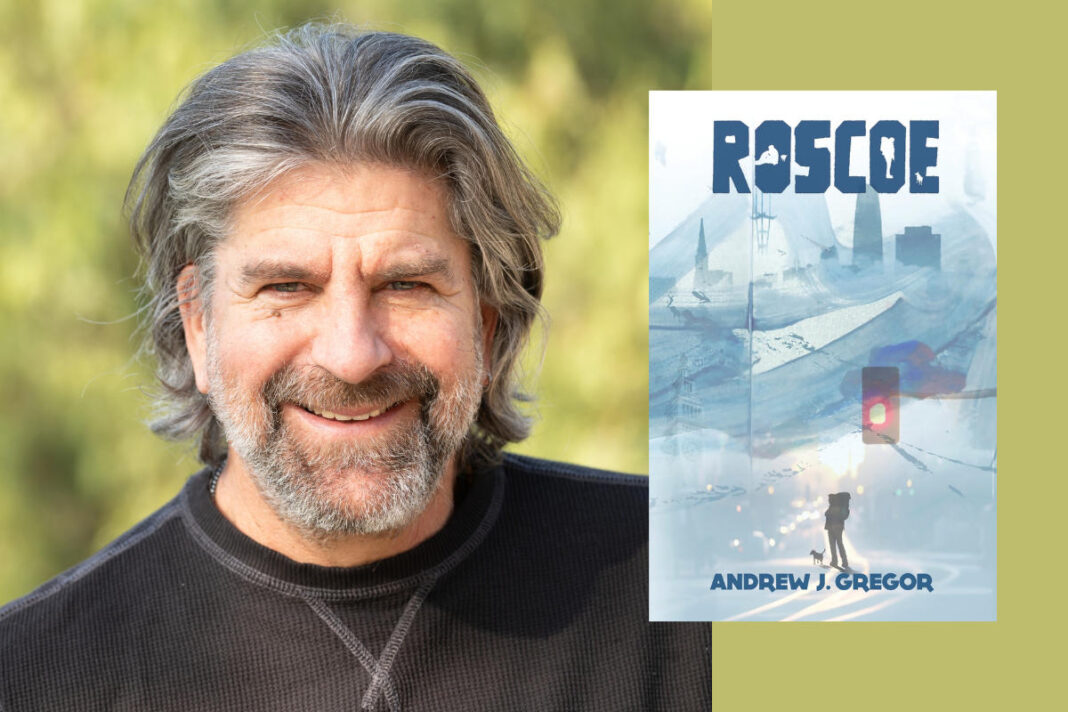
After reading George Orwell’s Down and Out in London and Paris, at 18, Andrew J. Gregor decided to spend a weekend sleeping on the street. What he remembers most vividly is the feel of the cold asphalt.
This sensation is what introduces his sophomore novel Roscoe, a day in the life of a homeless person. Roscoe is a 62-year-old unhoused individual living in San Francisco with his dog Gepetto. The book Roscoe is heavily character driven, written in a stream-of-consciousness style that puts us as much in Roscoe’s head as in Gregor’s.
Gregor wrote the novel in four weeks, with the goal of changing the way those who read it view homelessness. He has lived in both Germany and the U.K., but in his view, America’s lack of social safety net leaves people particularly vulnerable to homelessness.
While living in Berkeley in 2010, Gregor came close to homelessness himself. An architect by trade, his means of living came from home remodels, something that became scarcely needed after the 2008 housing crisis. He started living in his car until parking tickets piled up and the threat of being impounded loomed.
“I don’t really get scared much, but I would get pretty nervous,” he said. “I couldn’t see a way out.”
In a 2022 study of factors associated with mortality among older unhoused adults in California, Rebecca T. Brown (an LDI senior fellow and assistant professor of medicine in the Division of Geriatric Medicine at the Perelman School of Medicine) collaborated with authors from the University of California San Francisco. They found that the population of single adults over 50 experiencing homelessness has steadily increased since 1990. This study also found that a prominent characteristic associated with mortality was experiencing a first episode of homelessness over the age of 50.
When deciding his main character’s identity, Gregor thought back to his brush with homelessness and what it would have been like if he hadn’t found his footing again. In correlation with Brown’s study’s findings, he would currently be homeless at 64.
San Francisco is a prominent presence throughout the novel. For Gregor, the city is like a petri dish reflective of America’s complex relationship with homelessness. He’s noticed that while it’s one of the friendlier places to be homeless, he can’t help but gawk at the sharp wealth disparities that are ever present all over the city.
“I am incredibly disturbed by the fact that San Francisco has four or five or six million dollar apartments for sale, and we have people on the streets,” he pointed out.
According to the latest data gathered by the Point-in-Time count, there are currently around 8,000 people experiencing homelessness in the city. This number has gone down since the last count, but is still far from zero.
Gregor currently lives in Lafayette and previously lived in Berkeley, where he observes that attitudes towards homelessness felt hypocritical, as many were supportive of people experiencing it—until it came to their neighborhoods.
He explains that he’s not totally innocent of this, recalling an experience that completely shifted his behavior and view towards unhoused individuals. This happened when he was walking to the supermarket, and a panhandler asked him for money. Gregor ignored the man and then heard him call out that it would’ve been nice to be acknowledged, even if he had no money to give. He then came back and spoke to the man for half an hour, learning about his life and how he became homeless.
Many of the scenes and stories relayed in the novel come from conversations like this one, which Gregor began initiating while passing out sleeping bags and other supplies to unhoused people around Oakland.
“They are a vignette of people’s lives,” he said.
In the book, Roscoe is at constant odds with his environment, faced with his own juxtaposition next to the housed San Franciscans that carry out their lives around his own. He occupies himself with internal monologues that analyze the historical and social implications of his and other forms of marginalization.
Gregor delivers a monologue similar to those in the book when discussing the primal relationships between homosapiens and how we’re intended to live in mutually supportive communities. His monologue is done with less cursing though. If Roscoe is anything, it’s blunt and unfiltered, something that Gregor did intentionally to mirror the state of mind that a person might enter when all they have is the present moment.
The central thesis is that anyone can become homeless, inviting readers to put themselves in Roscoe’s shoes. Gregor doesn’t imagine this book will change the world, but feels that if even five people change the way they see homelessness and those who experience it, then it will have done its job.