

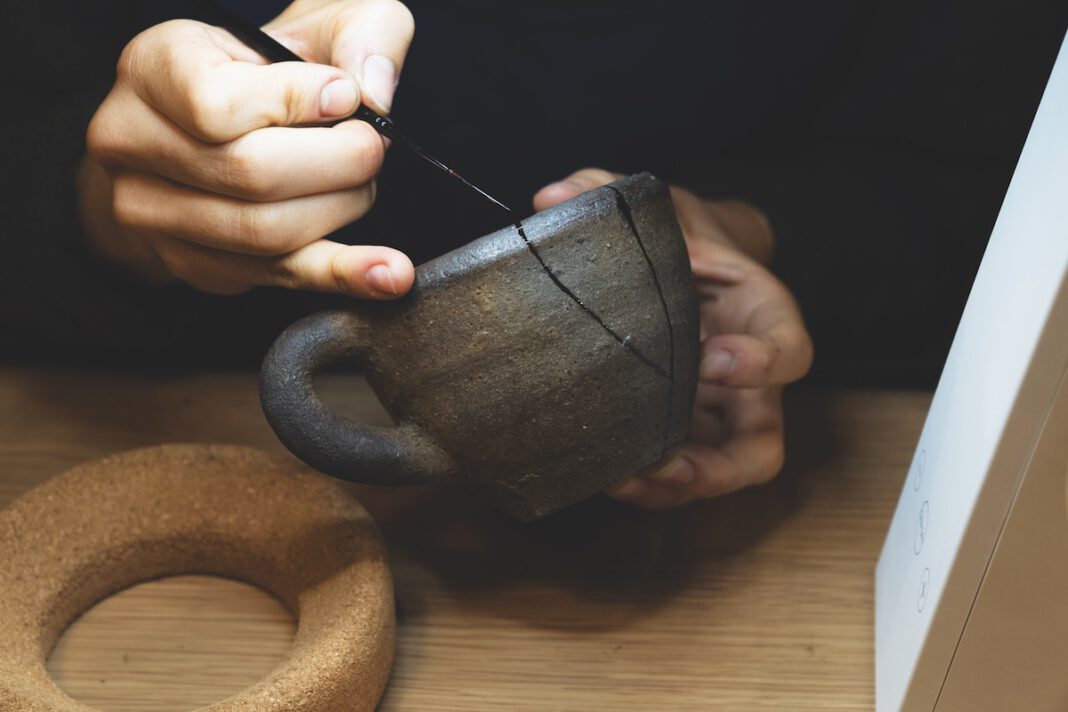
The classic folk story about the origin of kintsugi, the Japanese art of repairing ceramics, goes like this: Five hundred years ago, the shogun Ashikaga Yoshimasa, famous for his influence on arts and tea culture, sent a beloved Chinese celadon tea bowl back to China for repair. It was returned repaired with metal staples—still a method used in Japan called kasugai.
But the shogun didn’t like it and asked Japanese craftspeople to create a new method of repair. Kintsugi is the art of repairing ceramics without trying to disguise the mend, using urushi, a natural lacquer made from the sap of the urushi tree, native to East Asia, and either gold or another metal powder. The word “kintsugi” combines kin (gold) and tsugi (joining).
The history of the object becomes part of its beauty, thus also aligning with the idea of wabi-sabi aesthetics, which embody the acceptance of transience and imperfection. There are also connections to the Japanese concept of keshiki, meaning “landscape” or “scenery.” The patterns created by the repair can be seen as a new landscape in the piece.
And Zen Buddhism’s teaching of non-attachment also resonates, allowing letting go of how things “should” be, and appreciating them for what they now are.
POJ Studio is now offering traditional kintsugi classes in Berkeley for a limited time. Beginners start with “The Scene” ($170), a two-hour introductory class covering the first steps of kintsugi along with the cultural background of the practice. For those looking to deepen their experience with the art, POJ also offers “The Act,” a three-session series ($450), and “The Ensemble,” a six-session series ($780). The multi-session classes include the necessary tools and materials, including 24K-gold powder, and give participants the opportunity to work on their own broken ceramics, according to Tomoka Hayashi, director, POJ Studio US.
“We teach that broken pieces can be beautiful,” she said in a phone interview. “Kintsugi gives pieces another life.”
Hayashi explained that although Westerners might most readily identify kintsugi by its use of gold, it’s actually the complex use of urushi that is the most basic part of the process. Urushi trees require many years of growth before their sap can be harvested, and only a small portion of the sap can be harvested at a time. Urushi doesn’t simply dry through evaporation; it cures through a process requiring warm, humid conditions. It has been used in Japan for centuries, not only for repairing ceramics, but also for coating and protecting wooden objects, boxes, tableware, utensils and works of art.
In traditional kintsugi, gaps or missing fragments are filled with a paste of lacquer and clay powder, then sanded down once cured. Layers of the lacquer are applied, and then the pieces are placed in a controlled humid environment during the various stages of repair, up to a month in a humidor.
“The repair continues to get stronger over time,” said Hayashi. She compared this process to what humans undergoing hardships can experience.
In the introductory class, participants learn about the process and history during the first hour, then begin to prepare a broken piece in the second. Class members can bring in their own piece, which can simply be chipped or cracked, but it must be glazed ceramic, and less than 10 x 15 inches, Hayashi pointed out.
In the following series of classes, participants can continue to work on their original piece or bring in up to three more.
Hayashi noted that many Southern Californians, affected by the major fires and facing the loss of treasured items, turned to kintsugi to mend their pieces. The meditative quality of the process was also healing, she explained. “Kintsugi is a slow craft, and the challenge is to be present while engaging in it,” she added.
POJ materials state: “The practice requires patience and presence, making it an unexpectedly meditative way to step away from the noise and distractions of everyday life. At a time when we’re constantly scrolling, multitasking and moving on to the next thing, there’s something especially meaningful about sitting with one object, working with your hands and giving it your full attention.”
The POJ classes are being held at The Gardener in Berkeley, 1836 Fourth St., at least through November. Those wanting continued instruction can do so at POJ’s permanent studio in San Francisco, Hayashi said. Classes are open to ages 13 and older and can be scheduled through us.pojstudio.com/collections/berkeley-kintsugi-classes.