

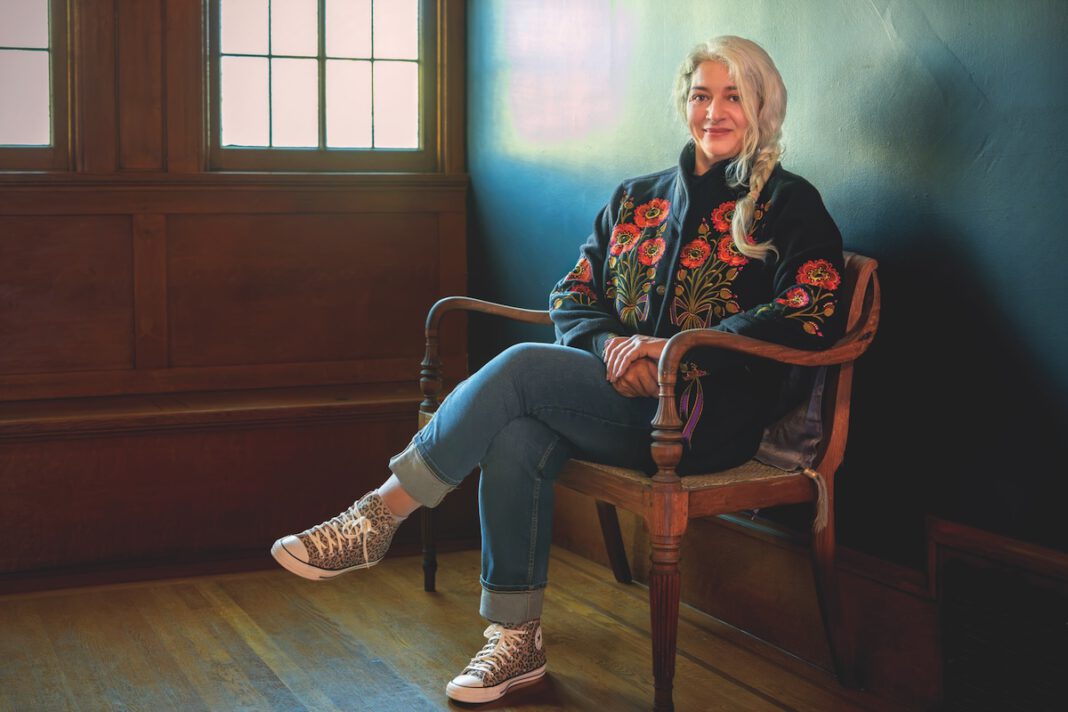
Trixie Garcia is her own person. That might sound like a simple assertion, but when one’s father is Jerry Garcia, carving out an independent identity requires deliberate, courageous intent.
When Jerry Garcia died in 1995, Trixie Garcia was just 20 years old. The loss reverberated globally, leaving millions of Deadheads rudderless. But inside the family circle, the grief was compounded by legal battles and sudden upheaval. To survive the noise, Trixie Garcia needed distance from the Marin County “hippie scene” of her upbringing.
She found her refuge across the bay.
“I moved to Oakland in the ’90s because I felt comfortable there—I felt like a real human,” Garcia recalls. Immersing herself in the East Bay’s exploding hip-hop culture, she found an authentic, raw energy far removed from her father’s shadow. “I ended up knowing people like Shaka G from Digital Underground, Tupac and Del the Funky Homosapien. I was just totally into that scene. It was my rebellion, and it helped me define myself separately.”
That period of self-actualization led her to art school in San Francisco, teaching art to local youth and developing her own identity as a visual artist and painter. Quiet moments in nature and her personal art practice became her grounding forces—qualities that carry her through the complex realities of her adult life today.
Once the dust settled from the legal battles,Garcia saw a need to step up for her father’s legacy. Today, she balances her painting with the immense responsibility of overseeing her father’s estate, music catalog and brand approvals—tasks she candidly admits involve “weird legal stuff and contracts” she otherwise has zero interest in. She also sits on the Grateful Dead board, navigating a collaborative consensus process with the band’s inner circle of family members.
Rather than viewing herself as the sole guardian of a sacred flame, Garcia views the Grateful Dead community as a decentralized movement that belongs to the fans as much as the music’s creators. It’s a shared heritage that has spread across generations.
“I don’t know that there’s one person that’s going to carry the torch,” Garcia says, reflecting on the natural evolution of the music, particularly following the passing of guitarist Bob Weir. “This is now a diaspora and is dispersed.”
Managing that level of public attention requires firm emotional boundaries. To protect her peace from social media toxicity and the intense, sometimes overbearing nostalgia of fans, Garcia visualizes a personal shield—a chrome, reflective layer of light that lets warmth in while bouncing away chaotic energy. When fan drama or stories of past downfalls surface, her goal is simple: Redirect people back to the healing power of the music itself.
That intent to offer something restorative also drove her decision to enter the cannabis industry with Garcia Hand Picked. Having witnessed the heavy toll that hard drugs took on her family life, Trixie Garcia wanted to reshape the narrative around the family name—steering the public toward a plant rooted in wellness and community.
Her approach to the plant is deeply personal and genealogical. Her mother, Carolyn “Mountain Girl” Garcia, was a pioneering cultivator who wrote one of the earliest guides on the subject, 1977’s The Primo Plant. Honoring both her mother’s roots and her father’s reverence for small-batch growers, Trixie Garcia insisted that Garcia Hand Picked rely strictly on sun-grown, craft cannabis. When the California market faced severe headwinds, she waited for the right local fit—eventually partnering with owner Eli Melrod and the Sebastopol-based team at Solful to bring the brand back to California shelves.
Looking forward, Garcia’s focus remains on collective stewardship and authentic storytelling. She is executive producing a new documentary about her father alongside director Justin Kreutzmann (son of Grateful Dead drummer Bill Kreutzmann). With the next generation of the Grateful Dead family—including Phil Lesh’s son stepping onto the board—taking on larger roles, there is a shared commitment among the kids to “fly, not stumble” as they carry the legacy into the future.
At her core, Trixie Garcia remains guided by the values of the 1960s counterculture: peace, love, community and sustainability. Through her painting, cannabis advocacy and her steady management of an iconic American cultural institution, she holds the love fans have for her father with profound respect—all while standing firmly in her own light.