

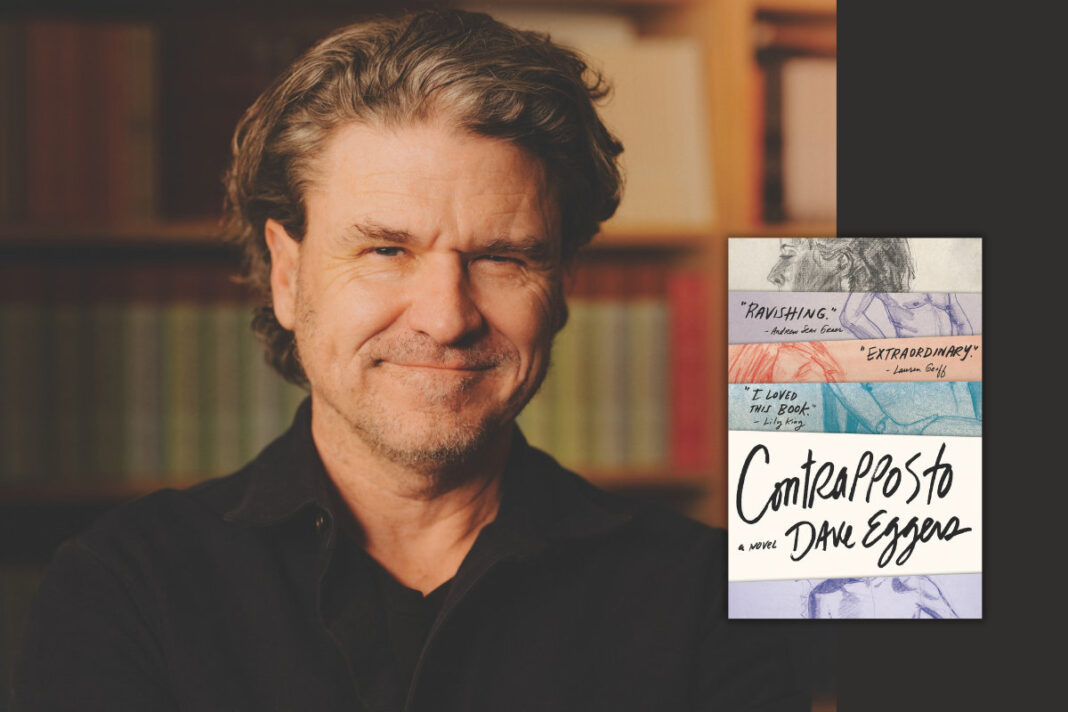
Using AI for creative writing is like lining up for a marathon, then getting into a car and driving to the finish line. “You didn’t run the race just because you show up at the end. You have done nothing,” says award-winning writer Dave Eggers in a late July interview.
We are speaking about the art of writing and his new novel, Contrapposto. The book’s central characters and themes tangle with topics such as artistic integrity versus commercial gain, crystallized thinking in arts education and the messiness of real life human relationships.
The narrative in Contrapposto—especially the stories of primary protagonists Cricket Dibb and Olympia Argyros—stretches languorously over five decades. San Francisco-based Eggers started writing the book 20 years ago, which he claims is the longest he’s ever taken to complete a book. The benefit at age 56 of having observed and experienced long-term relationships shows up in relatable characters who stomp, tip-toe, saunter, fling, stumble and float through life’s changes. Human relationships move in complex, dizzying patterns. Sometimes people vanish in the spin; others enter like fresh milk, churn and curdle, then emerge surprisingly solid, like aged cheese.
Cricket and Olympia go through a battery of connections, as accidental teenage friends who become colleagues, then lovers, collaborators, competitors, and for long periods live as distanced, used-to-know somebodies. Later in life, they reconnect and prove to have a most trustworthy, enduring friendship.
Equally but differently enmeshed are the many people in the book who seem trapped. They are permanent members of tribes they can never escape, despite vigorous efforts to do just that. Cricket’s relationships with his mother, best friend, teachers, mentors and others careen between cliff-hangers—either person might “lose the grip”—or slowly circle, like ships lost at sea, with the primary goal of remaining afloat.
In Eggers’ book and thoughts, fine art and commercial success perform similar wrestling matches. Two opposing positions grasp, push, pin, separate and occasionally knock themselves unconscious with vicious punches. In every encounter, the debate demands energy. The only possible “victory” over defeat comes with continued engagement. A winner might never be declared.
Eggers’ own life includes harsh blows cozying up with brilliant achievements. He first hit the literary world between the eyes in 2000 with a memoir, A Heartbreaking Work of Staggering Genius. The book was a Pulitzer Prize finalist and tells how, following his parents both dying of cancer within weeks of each other, he became at age 21 the acting parent of his eight-year-old brother. A person could lie down after such a jolt, but Eggers didn’t. Instead, he wrote a dozen novels, 20 children’s books, short story collections, and published multiple nonfiction works.
He also co-founded 826 Valencia, an educational youth writing nonprofit that meets local zoning laws by simultaneously operating as a pirate-supply shop. With 826 outlets growing to include locations nationwide (each has a different specialty store), Eggers’ enthusiasm for literature has not allowed him to rest or retire. He continues to run McSweeney’s, the nonprofit publishing company he founded in 1998, and most recently, announced the creation of Art + Water, an arts center that upon completion will offer free studio space to 10 established artists. The senior artists will mentor and instruct 20 local emerging artists free of charge.
Always a thoughtful educator, Eggers returns to comments about AI and writing, saying, “We adults, in our roles as parents, teachers, policymakers, university officials, have to draw a hard line, right now, and say that if we want young people to learn to write, they have to learn to write. It’s insane that I have to say that, but I keep meeting otherwise reasonable adults who think it’s OK to allow kids to use AI in their writing. This is cheating, plain and simple, because you are not writing when you’ve had a machine write for you.
“Kids must learn to write, to express themselves authentically with their own brains. Otherwise, the species is cooked. We’ve given up our humanity to machines,” he continues.
The humanity in Contrapossto is found in its vast love stories: those of romantic, platonic, sexual and familial love. The love of art and ideas, the love of liberation from lies. “Thanks for noticing that,” he says. “You’re the first person to put it in such terms, and you’re right. I wanted the book to be full of longing because both Cricket and Olympia are madly in love with the world and its beauty.”
Beauty in the book includes actual black-and-white drawings, most made by Eggers, who responds to readers’ letters almost daily, using quality stationary and pens he says make his words look “fancy and profound.”
Resistant to the internet racetrack, he begins a book with one word, such as “Cricket,” on paper. A few hundred pages of notes later, he boots up a 1998 MacBook Pro that has a cracked screen and uses the same copy of Word he’s used since 1999. “The software works well and has never needed to be updated; that’s one reason that machine has never been connected to the internet. The endless updates would drive me mad,” he notes.
While recognizing the immediacy of email, the expectation of constant contact is misguided and leads to everyone feeling needy and miserable, according to Eggers. “Today, teenagers might answer about 200 messages a day, from dozens of friends, which is far too much for a human to be doing while staying sane,” he observes. “The solution, thank God, is easy. We all need to set reasonable boundaries and change expectations back to something more rational.”
And texting, he is quick to emphasize, is not writing. Texting won’t help a writer become better at holding the reins of the many horses running in a novel. “With any longish book, you’re tracking a lot of characters and themes,” says Eggers. “It requires great care to make sure that no one character or theme is neglected for too long. At the same time, you can’t be too dutiful or even mathematical about it. The reader can’t see the work of tracking and threading. Structure is important, but it’s also important that the structure remain somewhat invisible.”
Scenes like one in which Cricket teaches his mother how to draw and other equally tender episodes are spaced judiciously in Contrapossto. Keen pacing awareness, learned by real life observation and writing numerous drafts, tells Eggers what must come before and after climactic scenes. The maturation and learned empathy of a child or the sudden understanding of a parent must feel natural, inevitable, in his opinion.
Placement of characters and events expressing the book’s most ambitious themes are equally nuanced. Carpenter, a character in Contrapposto, boldly protests judgment and competition among artists, a position Eggers holds. “Carpenter’s manifesto, where he declares that artists should only attack each other once they’ve solved every social ill that plagues the world, seems reasonable to me. Once you’ve ended all wars and tyranny, solved hunger and bigotry and inequity, then you’re welcome to turn your anger toward someone painting watercolors. But until then, fight the real enemies,” he suggests.
Eggers believes there are countless ways to live with integrity as a visual artist. He notes, “Most of the visual artists I know have carved out a very good life for themselves, free of the trappings of the more elitist and mercenary aspects of the art world. It’s very possible if you’re committed to doing it your own way.”