The San Francisco Bay is the biologically richest estuary in North America. Olympia oysters are a vital part of that, the population of which has drastically dwindled from its original abundance.
What was once a main food source for the Ohlone people was later gobbled up to near extinction by settlers during the California Gold Rush. Their hydraulic mining didn’t help.
By the late 19th century, planting of eastern oysters became a monopoly on bay mudflats, leading to oyster pirates who stole and sold them at Oakland docks. Literary icon Jack London was even named “Prince of the Oyster Pirates” for his participation.
Now, conservation groups are working towards restoring the native Olympia oyster population in the bay, done with the help of the Wild Oyster Project—and notably, their enthusiastic volunteers.
The Wild Oyster Project is a nonprofit organization founded by environmentalist Linda Hunter in 2016. Their mission is to restore the San Francisco Bay, one shucked oyster shell at a time.
Volunteers who work with the project collect oyster shells from partnering restaurants around the Bay Area for use in stimulating oyster growth. By providing a hospitable environment for young Olympia oysters, these shells eventually form oyster reefs that reinforce the shoreline, create habitats for other native species such as eel grass and filter particulate matter from the water.
“It used to just be that our founder was personally driving to restaurants and recycling,” said Giulio Salerno, executive director at the Wild Oyster Project. “Now we have a network of probably 20 to 40 volunteers.”
In addition to having volunteers scour restaurants for the remains of seafood feasts, the Wild Oyster Project runs outreach and education programs where volunteers are invited to play an important part in shoreline data collection.
COSMO, or Community Oyster Science Monitoring Opportunities, was a pilot program that the project started last year and continued to grow this summer. Volunteers assist marine scientists in counting the types and quantities of sealife on various shorelines across the bay, which oyster conservation groups then use to plan where their efforts will be most successful.
According to Jivan Khakee, a marine scientist with the Wild Oyster Project who co-hosts COSMO, pretty much no one monitors the shoreline except for them.
COSMO in Action
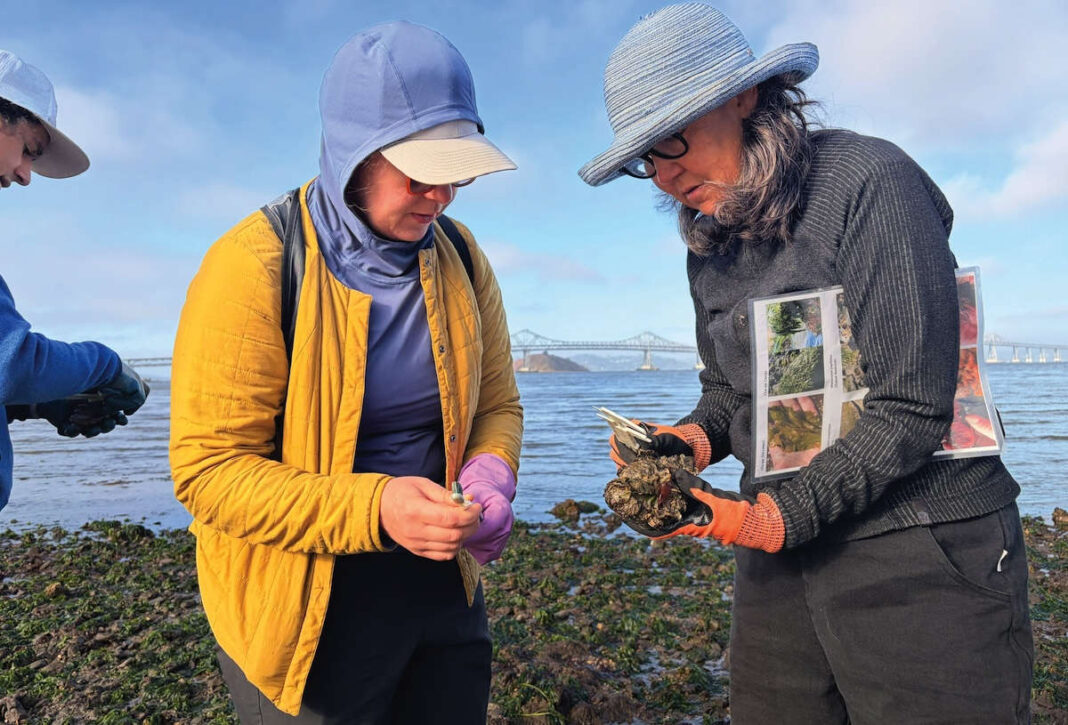
It’s 7am at Richmond’s Point Molate Beach Park, and volunteers are making their way across seemingly endless beds of algae that sort of resemble spinach casserole. Program director Casey Harper calls it sea lettuce. Fitting.
The group stops when Khakee starts putting down a makeshift transect with bright orange rope. This will be used as a boundary for the quadrat, a rectangular grid made from PVC pipes that marks off sections for counting and identifying wildlife.
Volunteers are taught how to spot different species, such as Ulva canopy and red algae, and are then assigned a part of the quadrant that they are responsible for analyzing to measure percent coverage.
Then, they count the number of oysters in each row and measure up to 10. Numbers fly at an intern holding a clipboard and making sure to catch each percent value that’s thrown at her. When they finish the first quadrant, everyone cheers. Khakee moves it a couple feet forward for their next analysis.
Three volunteers were present at this COSMO, each completely fascinated by the process in a way that is reminiscent of school field trips to the aquarium.
“This is so cool,” says Iam McFaul in a singsong tone, a sentiment he repeats throughout the event.
McFaul is an amateur botanist and certified master naturalist in California, Arizona and Texas. Participation in this volunteer program makes him qualified to catalogue data in various habitats, which he has done for the Border BioBlitz, a community science effort to record as many species as possible along the U.S.-Mexico border.
Once a San Francisco resident, McFaul saw the opportunity to do some ecology work during his visit in August and jumped at it.
Author and journalist Susan McCarthy came to this COSMO to reconnect with her undergraduate degree in biology.
“I love [that] there’s an amazing view, and we’re literally grubbing in the mud,” she said, referring to the Richmond–San Rafael Bridge in the distance, highlighted by a bright early morning sky.
This was the last COSMO of the summer. These opportunities to bring people out are few and far between due to the specific conditions they require. Sea levels must be low enough for data collection, and for volunteers to have the availability to show up, COSMOs are planned on weekends, two things that coincide only a few times over the summer.
Harper says that the Wild Oyster Project relies on its volunteers. When people feel like they’re a part of something, they take ownership and collectively push for its success.
“It’s kind of like the Olympia oyster,” she said. “One oyster on its own is quite small; it doesn’t matter much as a single individual, but collectively working together they’re a keystone species of the whole environment.”
National Oyster Day Wine and Oyster Tasting
Later that day, the Wild Oyster Project celebrated National Oyster Day with an oyster and wine pairing at Broad Street Oyster Company.
On the edge of Ghirardelli Square, participants sat in the meticulously decorated second floor of the restaurant, overlooking Alcatraz through a large window.
A portion of the proceeds from the oyster tasting will be used as fundraising for the project. Harmony Niles, leadership at the project and niece of the founder, guided participants through the tasting while educating those in the room on the importance of conservation efforts.
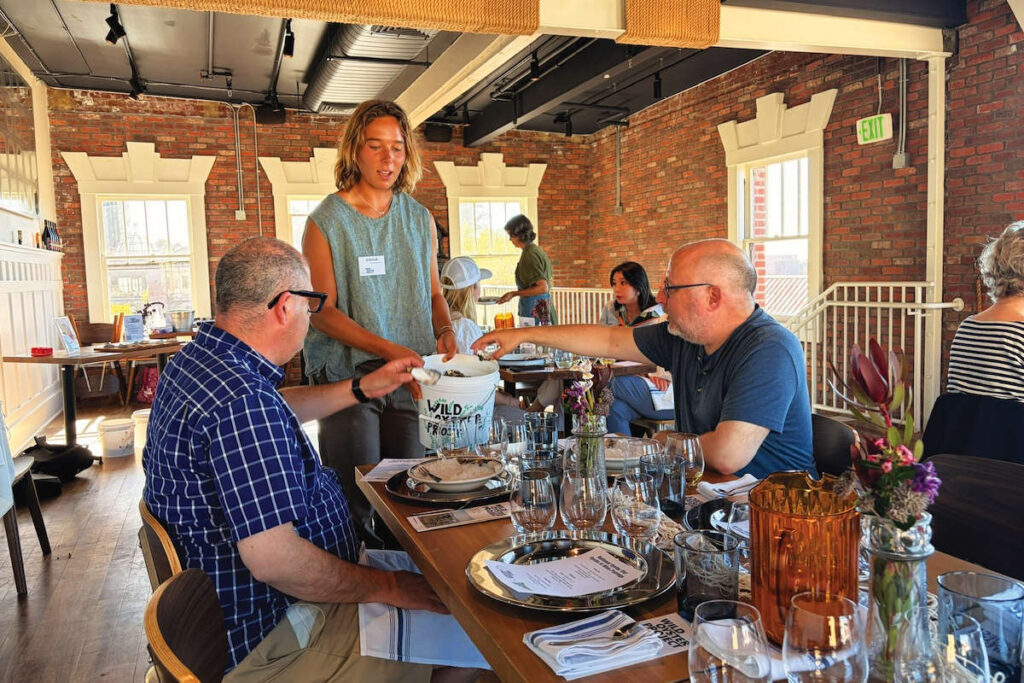
Three white wines were assigned to three different oysters, each with its own unique texture and taste. Place settings held a sheet with oyster tasting terms, allowing participants to identify the umami, mossy, bitter and sometimes even aluminum flavor profiles held in each rugged shell.
Amy Hephner heard about the tasting and wanted to learn more about the oyster mounds that she was only vaguely familiar with. After what she learned at the tasting, Hephner wants to do her part by asking restaurants she goes to that serve oysters if they are part of this recycling effort.
Once everyone finished their oysters and accompanying drinks, another member of the project came around with a bucket for participants to place their empty shells in. These will be used to build oyster reefs in the same water that lays beyond the restaurant’s prime view of the bay.
Niles believes these outreach events are necessary for bringing biodiversity back to these waters. This summer, the Wild Oyster Project also hosted a camp for kids as young as five years old to teach them about the shore and give them the opportunity to see and touch live Olympia oysters.
Some of these kids will eventually be the people in charge, so Niles wants them, along with volunteers and participants of every age group, educated and informed on what is at stake when native sea life is lost.
“I think that they’ll take that knowledge with them, not just to their friends and family, but into the voting booth,” said Niles. “You know, they’ll support politicians who care about biodiversity.”
After a tasting or a COSMO, it would be hard to forget how much these small, savory lifeforms do for the bay and how easy it can be to join in on the cause to save them.
For more information, visit wildoysters.org.