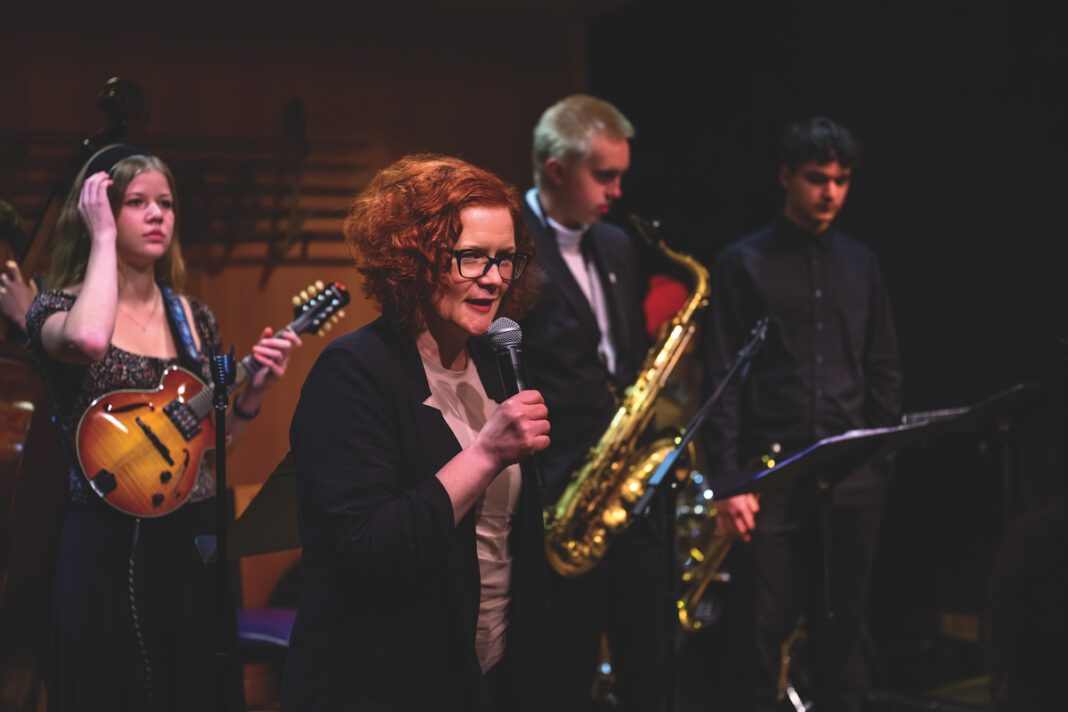
Lisa Mezzacappa leans forward in her chair, her eyes shining with delight as she talks about her first few months running the Jazzschool.
The Berkeley bassist, bandleader, composer and educator has spent the past quarter-century as the quintessential indie artist, producing a steady torrent of gigs, concert series and recording projects that have helped energize and define the Bay Area’s overlapping jazz and improvised music scenes. Sitting in her tidy office just off of Hardymon Hall, the lobby of the Jazzschool’s compact campus in the downtown Berkeley Arts District, she beams as students filter in for afternoon classes.
The summer quarter was just getting underway, “and as the day goes on, there’s an amazing swarm of activity,” she said. But it’s not just students who’ve been filling up the subterranean facility. She’s turned the space into a thrumming jazz community center. Each month seems to bring a new series or offering, and in many cases the programming is free. Late night hangs where faculty spin their favorite records, movie nights, guided listening sessions and lots of concerts are turning the Jazzschool into a destination for anyone who’s looking for a welcoming, jazz-centric oasis.
“We have this really cool flexible space that is a venue, a lecture hall, a lounge, and we’re experimenting with these different experiences,” Mezzacappa noted. “People seem to be enjoying that. I want the Jazzschool to feel like a community center. Not everything should involve an exchange of funds. People coming to free programs have also been giving little donations as a tip, a way of saying, ‘I appreciate this thing in my life.’”
On a recent Wednesday afternoon, I dropped in for one of the weekly Brown Bag Jazz Hangs, a free lunchtime series that features a musician holding forth on a topic they’re passionate about. This hour-long session was led by San Francisco alto saxophonist Beth Schenck, who provided insight into a career-spanning array of tracks by alto sax legend Lee Konitz (1927–2020) for a disparate assembly of about 15 people. The hangs continue through the month, with trumpeter Darren Johnston talking about the tragically short lived Booker Little on Sept. 9 and percussionist Javier Navarrette exploring the legacy of percussionist bandleaders on Sept. 16.
The fall quarter kicks off on Sept. 21, but the Jazzschool will be humming throughout the month. A fall open house event on Sept. 12 features a jam session, faculty presentations and previews of fall quarter courses and workshops. And a “Tenor Madness” double bill that evening featuring quartets led by James Mahone and Bob Kenmotsu highlights the fact that Mezzacappa has turned Hardymon Hall into one of the Bay Area’s most creatively curated venues. Upcoming shows include the resident Electric Squeezebox Orchestra led by trumpeter and Jazzschool mainstay Erik Jekabson Sept. 13, and the Dynamic Miss Faye Carol, a Bay Area jazz and blues icon, Sept. 19.
Mezzacappa has turned Hardymon Hall into one of the Bay Area’s most creatively curated venues, with month-long series focusing on underexposed jazz niches like Asian American and queer artists. She tapped powerhouse Oakland saxophonist Howard Wiley for last month’s schedule, which included drummer Jaimeo Brown’s Transcendence featuring Wiley and a concert by the LJ Holoman Trio, showcasing a gospel music-steeped Hammond B3 master with deep R&B and hip-hop credits, including Tony! Toni! Toné!, Mary J. Blige, 50 Cent and Raphael Saadiq.
Over at the Jazzschool jam session held Wednesday nights at Jupiter, high school players waited their turn to sit in with the rhythm section alongside professional masters like Berkeley flutist Jane Lenoir, who’s known for her work in Brazilian and classical music. Trumpeter Erik Jekabson, the longtime director of the Jazzschool’s Young Musicians Program, hailed Mezzacappa’s hiring as a major boon to the school, while drummer Jon Arkin, who’s performed at the Jazzschool in a variety of contexts over the years, said she was a brilliant choice for the job.
“I thought of her immediately when I heard the position was open,” he said. “She’s got so much energy. You know she’s going to make things happen.”
Among her new initiatives there’s the After Hours Vinyl Lounge on Friday nights, where Jazzschool faculty and staff hung out and spun their favorite albums from the in-house library. And the next offering of the Jazzschool’s Jazz Movie Night, Sept. 17, presents a free screening of 1999’s The Fillmore, a KQED-produced documentary partly inspired by Elizabeth Pepin Silva’s book, Harlem of the West: The San Francisco Jazz Era. Under Mezzacappa’s direction, the institution has quadrupled down on its community orientation.
“My main strategy has been to trust my instincts, reach out, partner, invite, welcome and actively find who should be here, who is part of the jazz story in the Bay Area,” she explained. “Pitch your book club or listening party. When they have an idea for a crazy new music project, I want them to think of the Jazzschool first.”
In many ways, Mezzacappa was tapped to right a ship on an uncertain course. Veteran pianist and educator Susan Muscarella founded the Jazzschool in 1997 above La Note Restaurant on Shattuck Avenue as a community school with classes for beginners, serious amateurs or professionals looking to acquire new skills. But Muscarella always had a bigger vision. By 2014, the school had long since outgrown its Shattuck digs and moved to its present location in the basement of the historic Kress Building, while also taking over space on the other side of Addison Street and opening as the accredited California Jazz Conservatory (CJC).
While the Jazzschool continued to hum along offering classes to all comers, the CJC earned national attention as the first stand-alone conservatory offering undergraduate degrees in jazz studies. Muscarella often said she was trying to create a West Coast Juilliard for jazz, and for a while the conservatory graduated a series of stellar musicians, like pianist/composer Ruthie Dineen and drummer/vibraphonist Dillon Vado. With support from drummer and PowerBar co-founder Jennifer Maxwell, the CJC attracted heavyweight faculty, including drummer Gerald Cleaver and guitarist Liberty Ellman.
When Muscarella took on emeritus status in the fall of 2023, veteran producer Nick Phillips was hired to run the CJC, but within a year the school’s board of directors decided the conservatory wasn’t economically viable. Between the pandemic, competition from other jazz programs and the difficulty of attracting students to the Berkeley area due to the high cost of living, the CJC wasn’t able to meet its enrollment goals. With the CJC shuttered, Phillips moved on, but the Jazzschool was still thriving and in need of leadership. Mezzacappa was in the midst of one of her more ambitious projects, releasing an album a month on her label, Queen Bee Records, over the course of a year.
“I wasn’t looking for this job,” she said. “I saw the announcement via the email list. I thought, ‘Who would I want to see in that position? Who in our community is the right fit?’ A lot of organizations, when they hire a big role, tend to look past the local people to the hot person from out of town. It spoke to me that the call for the position was, ‘Do we know you already?’”
Mezzacappa is part of a rising tide of artist-led spaces in the East Bay. Saxophonist Nora Free, who led one of the early Jazzschool Jazz Hangs on pianist Geri Allen, and vocalist Tiffany Austin, who briefly studied at the Jazzschool, have turned Wyldflowr Arts in West Oakland into an invaluable creative outpost. And Sameer Gupta’s RootStock Arts in Temescal has followed a similar path as Mezzacappa’s Jazzschool, seeking to provide resources and community for working musicians.
“There’s definitely some energy percolating,” said Gupta, who led a Jazzschool Jazz Hang in July examining the intersection of jazz and classical Indian raga. “I talk to Lisa (Mezzacappa) a lot, and I feel like we’ve been taking inspiration from each other. She’s definitely the right person at the right place, building on Susan Muscarella’s amazing vision.”
At a time when human agency seems under siege, the Jazzschool is offering something that’s downright countercultural. Instead of the disembodied mediation of a screen, jazz requires face-to-face contact, close listening and ideally, emotional connection.
“Right now, we just need more humans making stuff,” Mezzacappa pointed out. “It might be our job here to keep reminding people of that. What we do is AI-resistant. Music is a gorgeous thing that keeps people connected and makes us feel more alive.”
The Jazzschool Community Music School, 2087 Addison St., Berkeley, 510.845.5373. jazzschool.org.