If income disparity in the U.S. were served as a sandwich, it would be sent back to the kitchen. Instead, creeping lethargy and other forces normalize the inequitable reality of life in 2026. No eyebrows rise when data shows the top 1% of wage earners receive roughly 15% of all income in the country (Gould and Kandrs, 2021). The middle class “American Dream” of economic stability and homeownership declines while the rich grow obscenely wealthy and the impoverished increase in number.
That imbalanced “sandwich”—a too-thick bread layer “owned” by a sprinkle of happy sesame seeds atop scant middle ingredients and a dry, cracker-like bottom layer—seems like the only thing on the menu. Consumers bite in, choke it down and feign acceptance.
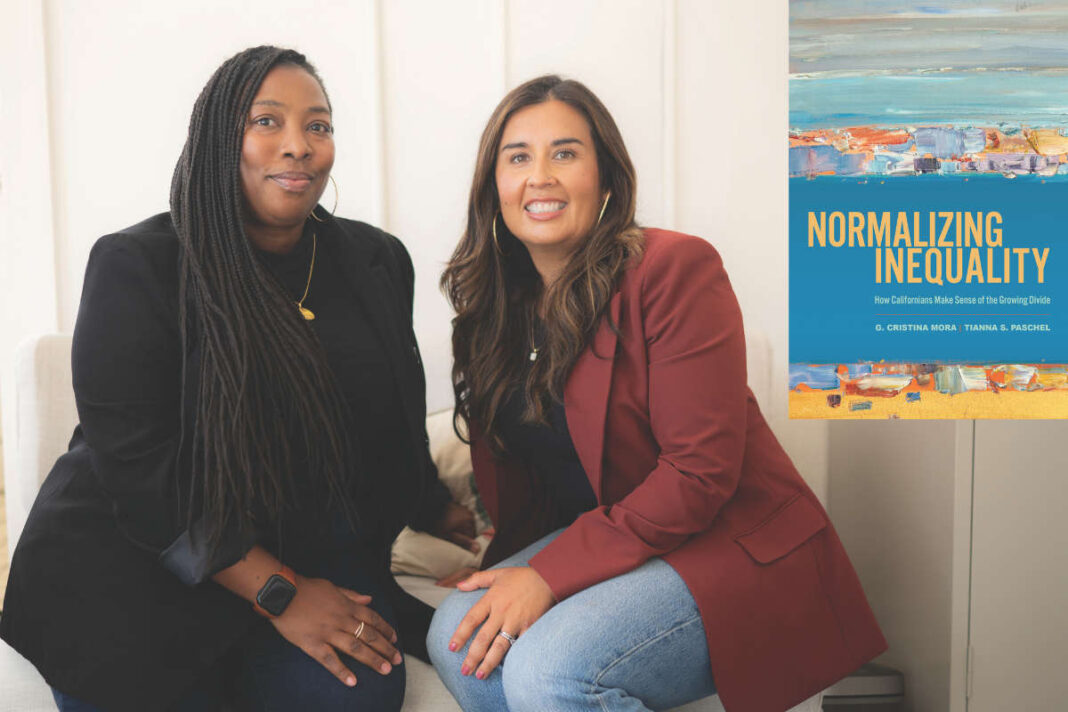
Turns out, the reasons people live with the inequitable divisions are not entirely mysterious. Arriving with extensive scientific research and their own set of hard data are two UC Berkeley professors, G. Cristina Mora and Tianna S. Paschel. Their new book, Normalizing Inequality: How Californians Make Sense of the Growing Divide, explains the structural and cultural conditions that allow people to navigate vast economic inequality, justify it and even passively reproduce it.
Mora is a professor of sociology and co-director of UC Berkeley’s Institute of Governmental Studies. Paschel is a UC Berkeley associate professor of African American studies and sociology. Because their book involves geography and race, it’s valid to note their backgrounds and racial identities. Mora grew up in an immigrant community in Los Angeles and is Latino. Born in Michigan, Paschel is Black and came with her middle class family at age seven to California. She grew up in Fresno, Bakersfield and Sacramento.
Their collaboration began with an orderly, structured process involving historical and of-the-moment research, meticulous development of interview methodology, two survey/interview phases, specific criteria for selecting and training everyone involved, and a special focus on the disappearing middle class in California.
Burrowing underneath surface understandings of racial and class inequality meant the in-depth interviews were best conducted by local residents in each location. “Recruiting people with similar geographic background and race to interview participants makes for interesting conversations that might not be shared outside of one’s immediate group,” says Mora, in a shared interview with Paschel.
Three findings they identified provide focus about how middle class Californians navigate, normalize and unintentionally contribute to inequality. Agency and individualism play out in all three: exceptional framing, spatial comparison and bounded blame. Respectively, people see themselves as exceptions distinct from statistical averages, and/or view the inequities as “not as bad here” as in other places and/or pathologize specific groups—immigrants, Black and Brown people, the unhoused—as both sufferers and perpetrators of structural bias.
The writers had multiple “ah-ha” moments throughout the process. Paschel says, “During team meetings and conversations with Cristina over this eight-year project, the biggest surprise was how people would sit with contradictions. They understood the roots of the problems—tax codes favor the wealthy, structural racist history shapes the present—then they’d fall back on minimizing individual narratives. They weren’t blind to inequality, but it didn’t lead them to progressive positions.”
Their book is weighted with data but enlivened by personal stories. The narrative makes abstract data points relatable. “With us being out front about who we are and the feelings we bring to the issue, that makes our book different,” notes Mora. “There’s deep poverty in California that we all live with and have to make sense of.”
Paschel’s early experience arriving in California from Michigan was “like moving to a different country.” Curiosity became and continues to be her super power. As a Black mother, she says the complex embrace-don’t-embrace in the Bay Area is “like whiplash.” Now, economically advantaged as part of the upper middle class, Paschel remains familiar with precarity and states, “I’ve made it, but most of us have not. Also, the more you approach the upper middle class ceiling, the more you hit your head on it.”
Mora recalls noticing segregation early on. Other Los Angeles neighborhoods just five miles away from hers had more trees, nicer schools, different houses. She says, “Our neighborhood was not the stuff in Hollywood movies or big TV shows from the ’90s. Other schools didn’t have metal detectors, school police, high teacher turnover. Ours did.”
She grapples with racialized undertones she and her children have experienced in Berkeley schools. In a city that purportedly welcomes diversity, she wonders, “Are schools that are thought of as ‘good schools’ also good for children of color?”
No conversation about socioeconomic disparity in California dodges housing. Paschel says impoverished people experience overwhelming inequity, but even families with two college degree wage earners are pinched. “They can still not be able to afford a house. We have lots of good tools to understand the patterns for people at the shortest end of the stick. (In our research), we thought about families squeezed in the middle and looked at how they experience inequality,” she points out.
Eager to avoid their research being misused in policy debates, they express healthy apprehension when laying out recommended solutions. Even so, racial repair, housing for all and improved treatment of immigrants appear on a short list. Paschel says recognizing how people have and continue to minimize the disparities is essential. Ethics studies courses in high school start young people thinking about the way historic inequity is enmeshed in current experiences.
“Policies are great, but it will take conscious shifts, deeper education, long-term buy-in for changes and radical thinking for creating solutions,” says Paschel.
In a separate interview, Ryan Finnigan, deputy director of research at Berkeley’s Terner Center for Housing Innovation, identifies two primary “culprits” underlying the middle class’ current housing problems. “Prices for purchasing and renting homes remain stubbornly high and have been rapidly increasing for decades. For middle income buyers, there’s not enough production for first-time homeowners, meaning smaller homes and condos have fallen short,” he says.
Terner Center research shows that in 2021, adults who own their home in California stood at just 43.5%, more than 15 percentage points lower than the rest of the United States.
Combatting the problems requires more zoning that supports middle density housing like three-story apartment buildings. Simplifying and expediting the permit, inspection, environmental and liability approval processes can help. According to Finnigan, these measures make new construction and development projects more financially viable. He mentions recent state laws such as Senate Bill 423 that allow specific land use projects to follow a streamlined approval process exempt from environmental CEQA reviews and other lengthy permitting.
Some urban communities with small city cores are proactively making housing development easier, according to Finnigan. Lacking the land of rural areas, they turn to urban infills for new development. “But in other places, big cities and rural, it’s the high land and construction costs that mean the economics just don’t work out. Until loans come back down, you won’t see more housing in those areas,” he explains.
With no one quick-fix for the entire state, Finnigan says differences between regions in the Bay Area add complexity. “In the East Bay, existing income inequalities, entrenched historic poverty, racial segregation and the ripple effect of rising incomes in San Francisco and the tech sector causing people with more resources to move in, all add challenges,” he notes. Magnifying everything are inadequate public transportation, wide income disparities, and barriers to zoning changes and new construction models such as ADUs.
Finding another longtime observer of people and the economy in the East Bay requires no more than a visit with Jim Maser, owner of Picante in Berkeley. He says he’s never seen such a rapid pace of change. Customers relied on used to be sincere, expert advisors known as “mavens.” Now, there are influencers, and people consult their phones, avidly following, then ditching, trends. That pattern is unsustainable for any business, Maser insists.
While fine dining establishments in the Bay Area that land at $200 per person are faring better than ever, and restaurants serving the low-income customer are stable, middle-income restaurants suffer a host of problems, according to Maser. Among them are societal changes due to Covid. Diners forced to accept to-go pickup or delivery learned any cuisine was available without dining in person.
“People stopped gathering,” he says. “For essential workers, it was fantastic for some and a curse for others. Meanwhile, huge food monopolies ramped up prices and pushed inflation hard. You and I know, once they’re set, prices never go down.”
Dining came back gangbusters in 2023, then tailed off. As people used up disposable income and minimum wages rose, the squeeze was on. “The prime costs for an operator are food and labor. It doesn’t matter how many robots you employ. I employ two, but you only have one choice and that’s to pass the costs along. You can’t reduce any other (in-house) costs to meet the two prime costs,” Maser points out.
The playing field is leveled, and restaurants are changing their menus, trying to remain competitive. But smash burgers will not save a mismanaged establishment. “It’s a long, never-ending race, and along the way, the track changes on you,” he says. “It’s tough if you’re thin-skinned. You really have to work.”
Making his guests happy is Maser’s greatest desire. Picante thrives by way of his passion for its cuisine, intense attention on management, astute real-time pricing, and three decades of listening and adapting to customer feedback.
Viewing all of the ways economic inequality impacts contemporary life, the problems appear insurmountable. Which does not suggest doing nothing. Instead, these and other voices with experience and decades of knowledge urge everyone to look, listen, question, resist and work to find new ways to address age-old inequity.