

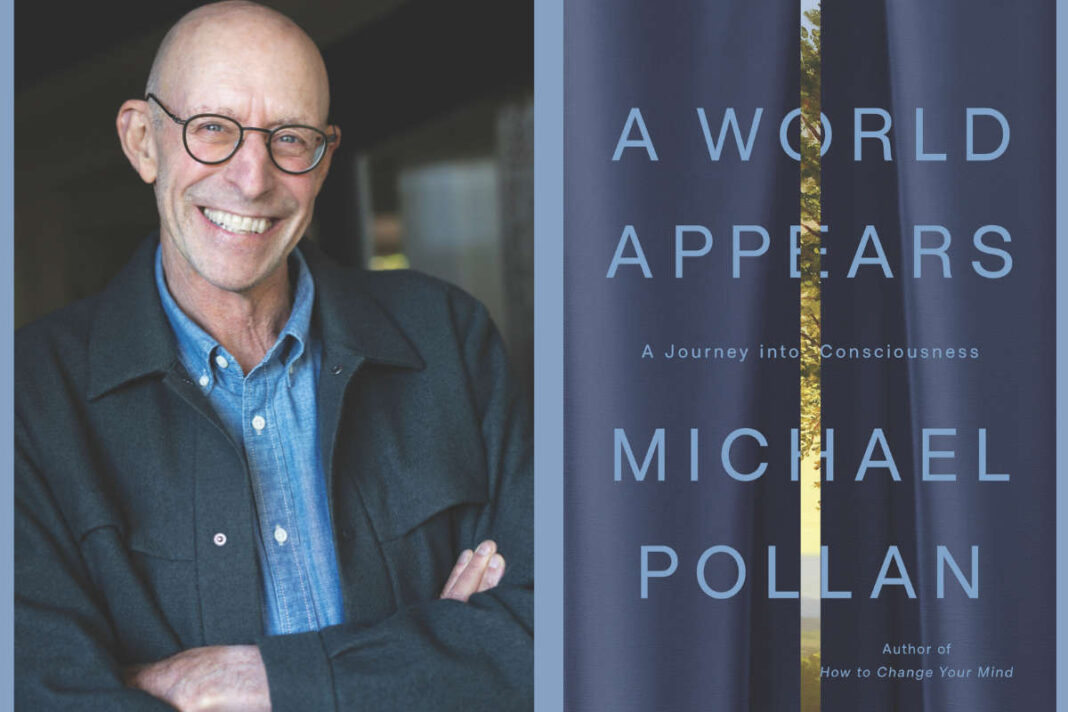
The passage of time, 10 best-selling books and countless essays for The New York Times Magazine and other publications make it clear that Michael Pollan has no off button. Appearing March 10 at First Congregational Church of Berkeley, the Berkeley-based writer introduced his new book, A World Appears: A Journey Into Consciousness. Presented by Mrs. Dalloway’s bookstore with the Elmwood Business Association, Pollan was joined in conversation by cognitive scientist Maya Shankar, creator of the podcast, A Slight Change of Plans.
From the get-go, the evening showcased two curious minds engaged in what could be called a high-spirited neurological game of ping-pong. There was structure, deep science talk and name-dropping—William James, Proust, Virginia Woolf and more—but also improvisation. The aura of spontaneous joy—and the fun they had thinking, listening and speaking in harmony or otherwise—was infectious.
A brief Q&A at the end of their presentation carried similar energy, with Pollan genuinely thrilled by questions to which his answer was often, “Thank you; I hadn’t thought/known about that before,” followed by whatever came to mind. His responses connected back to the research and associations in his new book—or hinted at topics his ever-curious mind might soon explore.
While his previous books delve into everything from food to psychedelics, the new one shifts from the body’s gut to the brain—more specifically, to the mind and consciousness. Wisdom from philosophers, artists and faith leaders intermixes with interviews Pollan conducted with cutting-edge scientists, along with personal anecdotes. Four primary chapters address sentience, feeling, thought and self. The investigation expands beyond humans to include consciousness in animals and plants, and whether AI can, will or should strive toward it.
Mirroring the most compelling parts of the book, his conversation with Shankar was consistently engaging—like tap dancing through a dense topic while draped in a cloak of heavy science. When Pollan the person emerged—revealing his mind’s wanderings and his struggle to grasp definitions and truths—he proved an especially compelling storyteller.
“The full topic, people have been cracking their heads on it for thousands of years,” he said. “I’m a curious human who happens to be conscious, and I’m pretty good at explaining things, so I went ahead and took the plunge.”
One rabbit hole he explored was plant consciousness or sentience. He described a group of renegade botanists testing whether they could teach a plant a lesson. “Yes, you can teach a plant, and it will remember for 28 days, which is 27 more than a fruit fly,” he pointed out. “They can hear and see, imitate a leaf shape to colonize it… They recognize self and kin.” As evidence, plants placed in a pot will compete for resources with unrelated plants, but share with kin. Another curiosity: A Venus flytrap given a surgical anesthetic can be “knocked out” for a period of time.
While humans rely on guessing and the brain’s predictions to fill in perceptual “blanks,” he said the primary difference between us and a smart appliance, bat or plant is that “we’re not just aware; we’re aware we’re aware, which is pretty wild.”
Pollan attributed automatic body processes to the brain, and consciousness of mind to the need to navigate social realities. “You need to be able to imagine yourself into other people’s heads—theory of mind. It’s a big survival mechanism,” he noted.
Getting from neurons to consciousness remains an enduring scientific dilemma. “The more you press on it as emergent, the more it sounds like abracadabra. That’s the hard problem,” he said. Pollan suggested that a “new kind of science” may be necessary to study such complex questions, including AI’s role in the future.
The most intriguing audience questions had no immediate answers. Dual consciousness in actors, pre-lingual awareness and the earliest expressions of consciousness, including hunger, thirst, itch, pointed to more rabbit holes Pollan may yet explore as his inquiry continues, with no end in sight.
‘A World Appears: A Journey Into Consciousness’ by Michael Pollan, published Feb. 24 by Penguin Press, $32, available at most bookstores.