

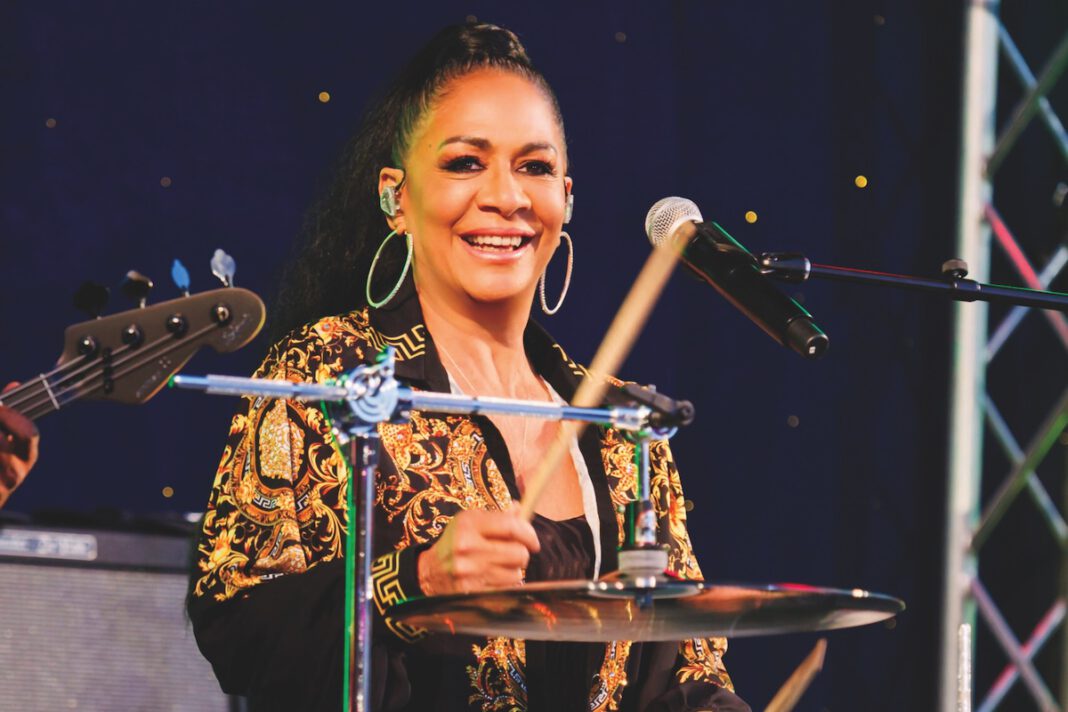
Sheila E. knows the power of silence. Recognized for her dynamic artistry and rigorous drumming, the Grammy-winning Bay Area-born musician in an interview in late May speaks words like a sprinter but never hesitates to pause, allowing drama to build and her thoughts to collect energy.
The conversation comes just prior to her appearance on May 30 with Oakland-based Bandaloop, a vertical dance company whose innovative work is celebrated worldwide. The concert at EPACENTER in East Palo Alto is part of the arts center’s inaugural Sunset Concerts season.
“I have no idea what I’m going to do with Bandaloop,” she says, laughing gently. “I’ve never played with them. I’m excited to even meet them. There’s no rehearsal; it will be improvised, I guess. I might just be an innocent bystander.”
There’s absolutely no chance Sheila E. will “bystand” anyone these days, having begun her career in a public performance playing drums for an audience of 3,000 at age five with her father, percussionist Pete Escovedo. She went on to join Prince in 1980 and rose to iconic status as a woman artist in the male-dominated industry by performing with Diana Ross, Marvin Gaye, Beyoncé, Ringo Starr, Lionel Richie, Gloria Estefan and many others.
Sheila E. is the first female percussionist to receive a star on the Hollywood Walk of Fame. In 2026, she is heralded as a multi-instrumentalist, singer, composer, producer, memoirist and humanitarian.
She attributes her never-give-up drive to her mother, whose strength is “the rock and the glue of the family.” Growing up, her mother would tell her she could do and be whatever she wanted. Her mother was an athlete and always competed with boys, advising her daughter that as a woman, she could be just as good as the men.
Success in her definition is not monetary. “It’s being happy and [doing] what you love or [being] a blessing to someone every single day,” she says. “To bless someone, oh, there are so many ways. Being kind, [offering] kind gestures, saying, ‘Hey, have a great day.’ I get to bless people with my music, that’s huge … and learning people’s names and even looking at each other. A lot of people are looking at their phones, not even engaged. That’s disrespectful.”
The business practices she holds onto are not spending more than she earns, investing and saving for the long term, and having all financial and artistic decisions she oversees pass directly through her. “I wish in my 20s I knew then what I know now,” notes Sheila E. “As young people, we don’t think of and are not taught to save money for the future, for when things get hard. Covid—no one expected that, and it was devastating to the state, country and world.”
Her family relied in part on food stamps and welfare during her childhood. Only if her father played a successful gig did they go to a restaurant after church on Sundays. Ordering pork chops, she says, “was a big deal.”
Decades later, regardless of how many people are on the payroll, everything comes to her first. “I say yes; I say no. I write all my checks; every budget, I approve. A long time ago, I learned that even having people you actually trust and think will take care of you, they don’t. What ends up happening is they take your money. They do other stuff with it, and next thing you know, it’s all gone. I learned the hard way,” she admits.
Offering advice to students attending her Oakland-based Elevate Hope Foundation programs and to young professionals coming up in the field, Sheila E. says change in the music business is too slow or non-existent. She continues by saying that women producers are overlooked, streaming is “a blow to society, culture and music,” and record labels exploit artists, offering them only one-quarter of a cent for each stream.
“It’s our works out there,” she says. “To me, music is like water, like food. It’s a humungous tool for people, and it’s healing. Yet we’re still fighting for the right to properly get paid. It’s a disgrace.”
Interwoven in her life and music, there is family and faith. In addition to her father, there are four musical uncles, and the heritage of her godfather, Tito Puente, who died in 2002. The family talks about and shares music daily. She might say to her parents, “Listen, Moms and Pops, to this new young artist I just found.” Family members hang out together, play games, go to movies and attend shows to see other artists perform.
“We live as a family, love each other, and we’re literally always thinking of ways to help not just each other, but other people,” says Sheila E.
Her faith is an anchor and includes daily prayer. “As soon as I wake up, I’m thanking God. I send prayers out to others. You try to get up with a sense, no matter what happened the day before, that today’s a new day,” she states. Reading the Bible daily and listening to gospel music of new artists, who she says “are unbelievable,” leaves her to conclude, “I love God, and I’m nothing without Him.”