History has a way of pretending certain people didn’t exist.
In a region that prides itself on progress, women who built institutions, changed laws, fought segregation, defended bodily autonomy and reshaped culture have largely vanished from the public record. Their names are missing from monuments, street signs, statues and textbooks. Their work survives, but their stories do not.
That erasure is what drove journalist Rae Alexandra to rage—and eventually to obsession.
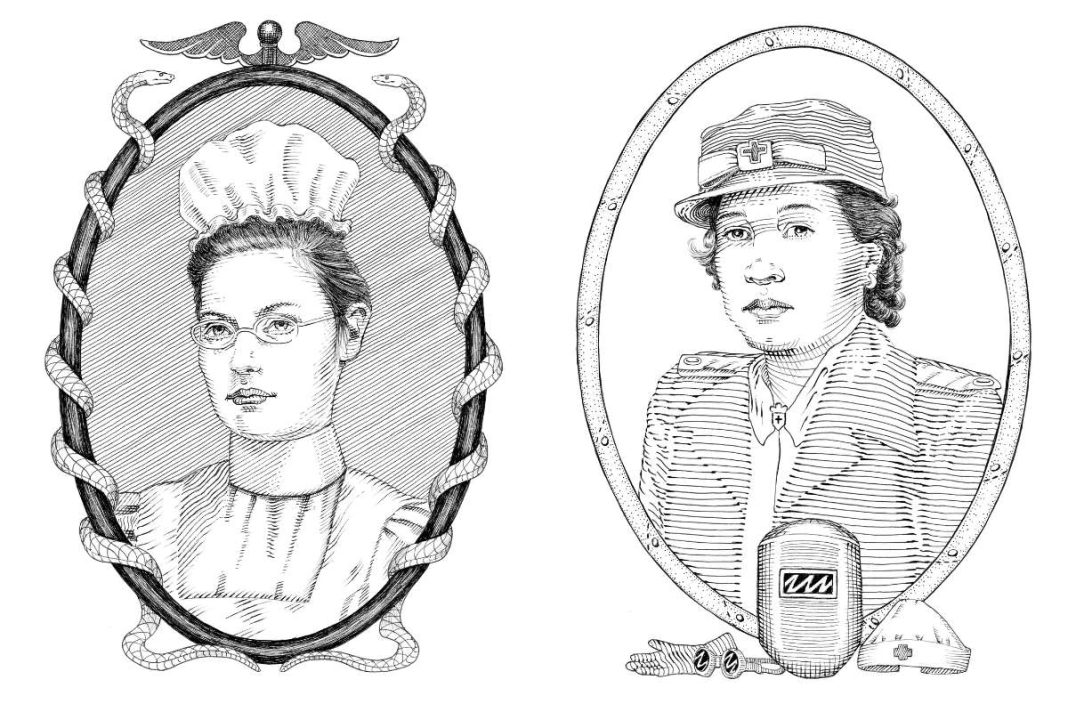
Elizabeth Thorn Scott Flood opened Oakland’s first private school for African American children in 1857, paving the way for desegregated education in California. In 1913, Piedmont nurse Bertha Wright founded Children’s Hospital Oakland and established the state’s first public child daycare center. Frances Albrier became the first Black woman to run for Berkeley City Council in 1939 and the first Black female welder in the Richmond shipyards during World War II.
And that’s just the beginning.
San Francisco lab technician Pat Maginnis helped lead the fight for abortion rights in the 1960s. Del Martin and UC Berkeley graduate Phyllis Lyon co-founded the first lesbian rights organization in the U.S. in 1955—and later became the first same-sex couple legally married in San Francisco. Disability rights activist Judy Heumann co-founded Berkeley’s Center for Independent Living in the early 1970s, laying the groundwork for the Americans with Disabilities Act.
These women, and dozens more, are featured in Unsung Heroines: 35 Women Who Changed the Bay Area, Alexandra’s forthcoming book, illustrated by San Francisco artist Adrienne Simms and published by City Lights. The book is adapted from Alexandra’s long-running KQED series, Rebel Girls from Bay Area History, which launched in 2018.
“To be frank, I did not know what I was doing,” says Alexandra. “I was just very angry about women being written out of history.”
That anger was measurable. As Alexandra notes in the book’s introduction, only 13% of San Francisco’s street names, statues, parks and public artworks honor women. So she decided to respond the only way she knew how: by writing them back in.
She committed to producing one profile a month. The research curve was steep. When pandemic closures shut down public libraries, Alexandra began buying every history book she could find online. The collection grew so large she eventually moved to a house in Stockton to make room for it.
But the work also created community. Each year since 2022, KQED has hosted “Rebel Girls” Bingo Nights, where Alexandra distributed zines featuring the women she had researched. Extra copies were dropped at bookstores, cafés and record shops across the Bay Area.
One year, she brought zines to City Lights Bookstore and was told to place them on the stairs leading up to the poetry room.
“I was so upset about this,” says Alexandra. “I almost didn’t leave any because I was like, no one’s ever going to find those.”
What she didn’t realize was that the stairs also led to the publisher’s office. The placement worked. A week or two later, City Lights called.
“There’s a thing we say in my house now when something is happening to us, like a momentary disappointment, and we’re all pissed off about it,” says Alexandra. “We’ll say to each other, ‘Put it on the stairs.’ Just as a reminder that the thing that’s bothering us now might turn into something wonderful later.”
Over seven years, Alexandra’s initially planned five-essay project expanded into 56 installments, with the final piece published on KQED.org in August 2025. Along the way, certain women changed how she understood Bay Area history entirely.
“Those women gave me a complete reframing of local history that I wasn’t expecting,” she says. “We all know about the earthquake and the destruction and the fires. But in telling the story of Mary Kelly, who became homeless and jobless with her family [post-1906], and then had to go to war with the city because the city was not distributing aid to the poorest refugees—reading her story really puts you in the center of the hellish circumstance of being in San Francisco at that time in a way that I haven’t considered before.”
She had a similar reckoning researching Myra Virginia Simmons, a domestic cook and newspaper seller who organized a parade protesting racist exhibits at San Francisco’s 1915 Panama-Pacific International Exposition.
“This is supposed to be the beacon that the rest of the nation is looking at, and also a symbol of San Francisco’s great rebuilding,” says Alexandra. “If I hadn’t ever found Myra Virginia Simmons, I wouldn’t have known about the egregious racism on display at that world fair, because that’s not how we like to remember it. When you start telling the stories of individuals, you get a completely different idea of what was happening as it was happening.”
Alexandra deliberately sought women from across the Bay Area and across lines of race, class and nationality. “This became an obsession,” she says. “If you only write about white women, you’re missing the full story.”
One search took years. Alexandra was determined to include a Palestinian woman. “It took me until May of last year,” she says. Even her best friend, whose family is Palestinian, told her, “It’s all men.” And Alexandra thought—that’s the problem. So she kept going.
Another challenge emerged: images. Many of the women—particularly Black women—were never photographed, or their images were lost.
That absence became the book’s second act.
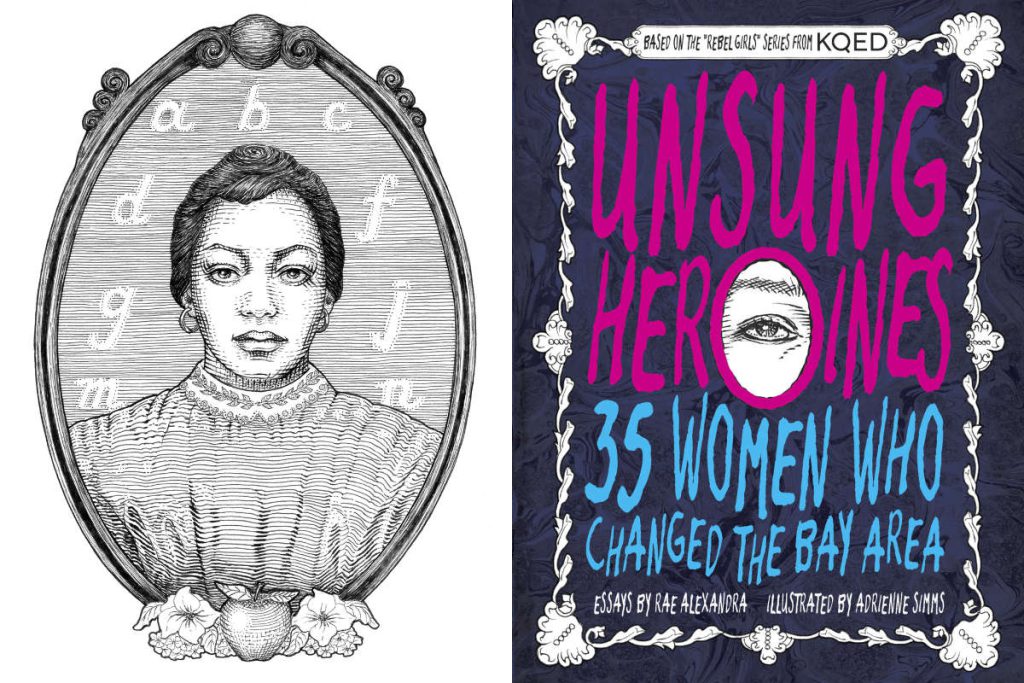
City Lights publisher Elaine Katzenberger met illustrator Adrienne Simms by chance at a swimming pool. Simms had recently self-published Portraits of Gaza, a zine depicting people whose lives were shaped by Israeli occupation, inspired by ancient Roman-Egyptian funerary portraits that rendered subjects regal and enduring.
Alexandra immediately knew Simms was right for the project.
“I was working with images that I didn’t feel reflected the women in the way that I wanted to,” she says. “Adrienne elevated all of them.”
Simms, a self-taught artist with an art history degree from Mills College, has exhibited her work for more than 25 years. Her influences include religious iconography, gold-leafed halos, ornate symmetry and mythic femininity.
“I always try to imbue my characters with a sense of independence, defiance even,” Simms says. “I like to create things that are beautiful and also powerful.”
For women with archival photographs, Simms created oval portraits framed with visual cues to their lives. Elena Zelayeta, a Mexican American cookbook author, is surrounded by ornate patterns, peppers, corn and avocados. Palestinian American activist Nabila Mango’s portrait includes both the Palestinian and American flags, alongside lilies—a nod to her love of gardening.
For women without photographs, Simms designed rectangular “scrapbook” frames built from artifacts. Charlotte L. Brown, who sued a San Francisco streetcar company for segregation in 1863, is represented through a legal complaint, a ticket stub and a horse-drawn carriage from the era.
The illustrations took a year to complete. “I tried to be very methodical because I didn’t want to rush anything,” says Simms. “As you can imagine, it’s very precise work. All those little lines took a while, took a lot of focus. It’s very soothing work in its own way, even though there’s a thin margin for error, but the work itself was very pleasurable.”
As she worked, Simms found herself awed by what these women accomplished under conditions far harsher than today’s.
She points to Dr. Margaret Chung, the first American-born Chinese woman doctor, who opened a Western clinic in San Francisco’s Chinatown in 1916, treated Hollywood stars, supported World War II soldiers, drove sports cars, wore men’s clothing, and dated men and women.
“She lived her life the way that she wanted to,” says Simms. “She succeeded career wise, and she was also helping other people. Back then, this woman was able to do all that when things were arguably even harder for women and people of color. We don’t have any excuses to hold back, you know?”
Unsung Heroines does more than recover forgotten names. It reframes Bay Area history as something built not just by earthquakes, gold or tech, but by pioneering women who refused to disappear. When we’re bearing witness to rights being rolled back and communities threatened, the book offers something quietly radical: proof that resistance has always lived here—and that the stories we choose to remember shape the futures we’re willing to imagine.
Sometimes all it takes is putting the truth back on the stairs.
‘Unsung Heroines: 35 Women Who Changed the Bay Area’ by Rae Alexandra, illustrated by Adrienne Simms; published by City Lights, to be released March 17, 2026. $16.95. Pre-order at citylights.com.
[Ed. note: This online article has been corrected to state the current percentage of San Francisco’s street names, statues, parks and public artworks that honor women; and the year that KQED successfully began hosting “Rebel Girls” Bingo Nights.]