

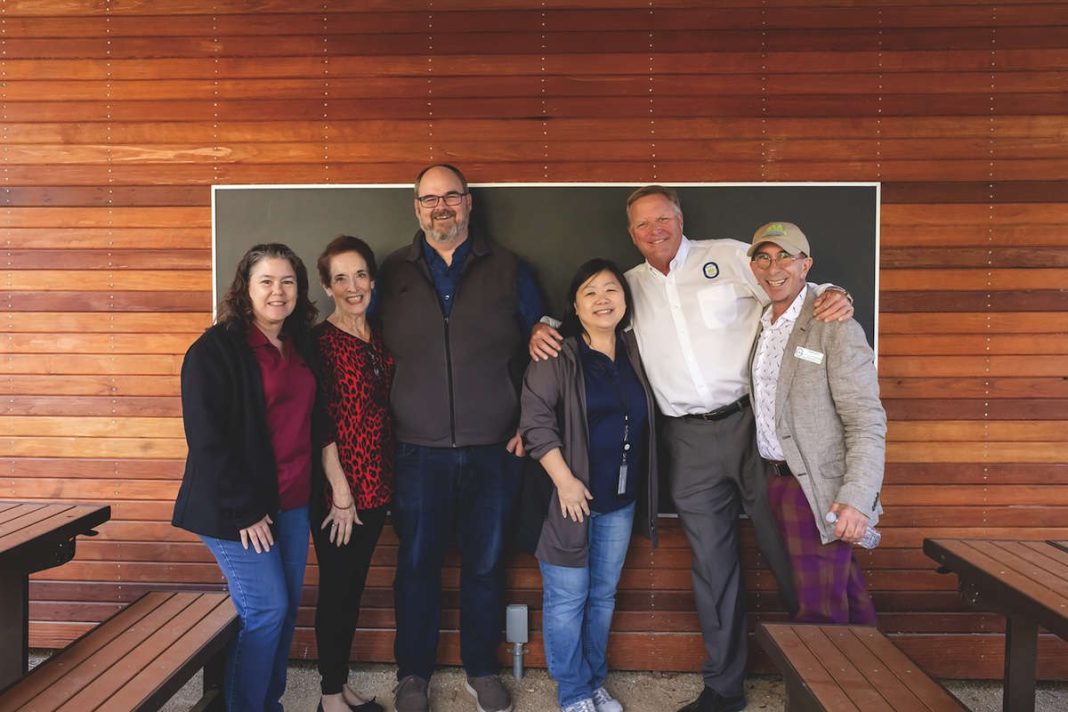
There are banks that make profit, and there are banks that work for the community. Fremont Bank and Public Bank East Bay share a common goal of improving the lives of communities in the Bay Area.
Fremont Bank is a community bank with locations all over the Bay Area, including San Francisco, Oakland, San Leandro and Hayward. Their purpose is to serve the community in a holistic way. Fremont Bank contributes 5% of their pretax profits every year for charitable purposes.
Recent grants from Fremont Bank Foundation include funding for homelessness programs, educational programs for children and infrastructure support for youth sports, nonprofits and community services.
And the way they give grants is not just a random giveaway. They listen to what the community needs. “The individual branch staff and the people who work at HQ on these things—when we say we’re embedded, it’s a lot of face-to-face networking and really listening to what the needs of the community are,” said Alli Moses, Fremont Bank senior manager of activation and community.
“It’s more of like, ‘listen and respond’ versus initiating or driving our pillars of giving,” Moses added. “It’s really giving the community a chance to tell us what they need, versus us seeking particular opportunities.”
While community banks bring dollars back to the community, public banks want to enhance that effort. Not yet formed, Public Bank East Bay (PBEB) is taking the steps to become a public bank, which will mean banking with a more systematic approach. They already have a nonprofit called Friends of Public Bank East Bay. The board of the nonprofit consists of bankers, financial experts, community leaders and government officials with the knowledge and skills to run a public bank.
“One of the things that we think is a big argument for public banks now is they’ll provide resilience against the crazy things the federal government is trying to do with California’s state and local money,” said Debbie Notkins, chair of Friends of Public Bank East Bay. They’re currently working on capitalization, a process where they have to attain a certain amount of money in case the bank fails. In this case, added Notkins, that amount is $40 million in capitalization commitments.
PBEB will be independently owned while the Friends of Public Bank East Bay board keeps the bank accountable. Notkins pointed out that although government officials will be part of the board, they will not take part in running the public bank.
“Because you’ll often have people say, ‘I don’t want my city government running the bank,’ and my answer to that is, ‘Your city government doesn’t want to run a bank,’” said Notkins. “It’s a professionally run institution with a lot of community oversight and transparency.”
Notkins explained that the bank will be a wholesale bank and not a retail one—they will not open up individual accounts. PBEB will act as a social service, establishing an office to serve governmental agencies, nonprofits and their partners, like credit unions and community banks.
Hayward Councilmember George Syrop said public banks would offer loans to fund affordable housing projects, support small businesses and work towards green energy infrastructure.
“A public bank would provide more access to capital in our community,” said Syrop. “Certainly, we try to encourage affordable housing development—it’s very complex together—in capital that’s necessary to make the project pencil (become financially feasible) and get an affordable housing project built. Having something like a public bank introduce more capital would lower interest rates, would make more affordable housing projects pencil and be able to help us address the housing crisis.”
The blueprint for a public bank exists in California law, called Assembly Bill 857, passed in 2019. It sets the rules and regulations for local entities wanting to create public banks.
By law, public banks have to partner with credit unions and local community banks. Notkins said North Dakota is an example of a public bank that works with both bank entities, plus it is the only public bank in the United States.
“You have more community banks and more credit unions, and more CDFIs (community development financial institutions), the ecosystem grows and the East Bay becomes an example of a thriving growing ecosystem instead of a struggling one,” said Notkins.
Noted Syrop, “When you have more CDFIs and you have our credit unions and community banks, that’s more access to financial institutions for your community, which means a higher level of financial literacy, less predatory lending, less folks falling into debt. It’s really about, like Debbie (Notkins) was saying, helping nurture an ecosystem of community bank financial institutions.”
Notkins pointed out that public banks can help community banks. For example, affordable housing projects currently come with a complicated capital funding structure. Instead, a public bank can offer to put a loan together with a community bank for an affordable housing project. The public bank would then take a certain percentage, and the community bank can keep the rest, Notkins explained. A public bank would give the community banks more time to pay them back, because of their mutual support for affordable housing projects.
Public Bank East Bay has big dreams for the communities with which they would partner. An infographic on their website shows that in Alameda County, they plan to build more than 3,800 affordable housing units, produce six million green megawatt hours (enough to power 54,000 homes for more than 10 years) and support more than 1,000 worker-owned businesses.
Community banks and public banks have two things in common: They believe their banking model works for the community, and the bank’s money will not end up in Wall Street. Not one bit.
Devon Johnson is Fremont Bank’s executive vice president and chief growth officer. “Fremont Bank is independently owned for the community. It means that we can take the long-term view,” he said. “We don’t have public shareholders; we don’t have to answer to Wall Street’s demands for quarterly earnings, so we’re able to look decades into the future to understand what the Bay Area needs.”
Councilmember Syrop explained that the repayment of PBEB loans will stay in the local area. “The funds coming back then get redeployed back into our community rather than being siphoned out into private and shareholder pockets in Wall Street,” said Syrop. “This is really an institution that, once it gets off the ground, its impact is keeping our tax dollars local. And that’s really the beauty of this project; it keeps our community wealth where it belongs, which is right here in our neighborhoods.”
Johnson noted that Fremont Bank’s dollars stay local as well.
“Truly, if a consumer places a dollar in our bank, that dollar goes directly back into their community,” he said. “And that impact is amplified through the jobs it creates, because the local business can hire more people through the homeownership it creates, through the social services that the nonprofit can provide.”