

Jasmine Rashid wants to empower us to redefine wealth as a holistic concept. The Oakland-based author’s resource, The Financial Activist Playbook: 8 Strategies for Everyday People to Reclaim Wealth & Collective Well-Being (2024), aims to “beautify the uncertainty,” welcome curiosity and demystify financial myths.
Rashid addresses how folks can harness the freedom we have in our financial decision-making to mobilize our values, uplift our communities and impact the greater good. Her playbook provides the strategies and encouragement to not only leverage finances for societal and environmental impact, but also to initiate these conversations in the first place.
Financial Activism
Rashid describes financial activism as a reclamation of the idea that financial systems should serve people, recognizing that they aren’t currently designed that way. Addressing financial activism’s role in overall activism, she realizes it’s often the missing piece.
“It’s like the elephant in the room for so many conversations about social change,” says Rashid. “How do we get the funds we need to fight against harm in our communities and build the necessary infrastructure to fix it?”
Growing up in suburban Long Island with her stockbroker father on Wall Street, Rashid was intrigued early on by the financial inequalities she observed. Her curiosity and inspiration from seeing creative financial activists in the Bay Area has propelled her career. Rashid is now a nationally recognized speaker and media contributor whose work has been featured in Forbes, KQED, San Francisco Chronicle, Inc. and other national media outlets.
As an impact investing professional, she’s worked with several social justice-oriented organizations, such as Candide Group, to strategize partnerships between wealth holders and community members. She’s also supported significant protests for social justice and initiatives like Families Belong Together. That campaign ultimately shifted more than $2 billion from the private prison industry holding migrants in inhumane conditions.
“There aren’t going to be some generous billionaires who wake up one day and decide to fix wealth inequality,” says Rashid. “Financial activism is about putting power back into the hands of everyday people, taking control of not only our own money, but the money all around us. It’s about remembering that the future is in our hands.”
Reclaiming Wealth
Rashid explains that tracing the flow of money, and the profit motives of social and governmental initiatives, can point out tangible actions the general population can employ to reclaim their political voice and power.
“When we put our money into institutions,” she says, “it’s often not neutral.”
This notion became highly relevant to Rashid’s work redirecting funds away from migrant detention centers in 2018. Families Belong Together included about 250 grassroots organizations led by migrants who had experienced the horrors of mass incarceration, detention and family separation. The coalition realized 70% of those detention centers were being run by private, for-profit institutions funded by big banks.
“By peeling back the layers of what money is doing in the world, and how it has consequential effects on our communities,” says Rashid, “the coalition really introduced me to the power of collective organizing and taking a stand to say, ‘We don’t want our money going towards these things.”
Talking About Money
Aside from her work with Families Belong Together, Rashid worked as an impact investor for seven years. Being immersed in the action, she recognized the position of privilege from which decisions were being made about capital flow for social impact. She also noticed that working class folks were often not involved in the conversation. This planted the seed for the philosophy behind The Financial Activist.
Describing the book as “a labor of love,” Rashid says the idea originated from a quarantine-era blog post in which she shared ways people could align capital with the movement for Black lives. As the post gained traction, readers were sharing their voices, asking questions and pointing out more opportunities to assess financial decision-making even in their own spaces, like local institutions, universities and places of worship.
“The book grew out of this online conversation,” says Rashid. “As I began having more in-person conversations with folks, exploring and teasing out this ecosystem of financial activism, which spans everything from decisions around thinking, spending, giving, mutual aid—all the way to investing, budgeting and some of the more complex kinds of systems.”
Admitting she’s not a financial expert, Rashid aims instead to be a friend accompanying readers on the learning journey—something she does masterfully through deep questions, skillful discussion and an inviting attitude.
“I’m not someone who has all the certificates or education in finance,” she says, “but I have the lived experience in being able to move through the world and see the ways in which our current realities of capitalism are not working for the everyday person.”
The first chapter of The Financial Activist Playbook is all about the act of talking about money itself as a form of reclaiming wealth.
“For the majority of us, the idea of even talking about money can give us butterflies in our stomach,” Rashid says. “Culturally, talking about money is still seen as taboo.”
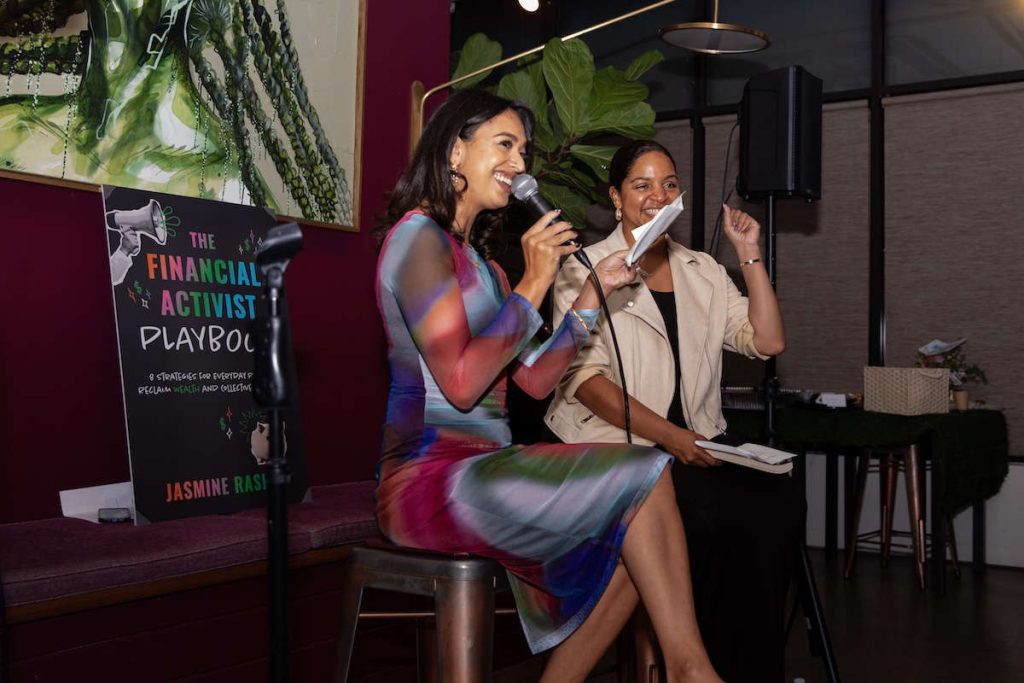
Adding the idea that financial literacy is typically inherited from one’s family rather than learned in school, Rashid emphasizes the importance of assessing our relationships to money. She suggests confronting the discomfort as a first step towards strong financial activism. Her book does just that through playful design and several workbook style exercises, equipping readers to direct successful movements, harness the power of their dollar, and most importantly, initiate impactful conversation through a lens of curiosity.
Local Action for Global Good
Though a New York native, Rashid does not hesitate to express her love for the Bay Area, calling it her true home. She acknowledges this region’s community of innovative activists and landscape of local businesses and organizations as a meaningful shaper of her work—especially in terms of the ways Bay Area residents can come together at the local sphere for greater global impact.
“Often most successful social movements around history begin locally,” says Rashid. “Why? Because that’s where relationships happen. It’s where we think not just about transactions, but the deep texture of being human together.”
Mentioning the Black Panther Party and several other movements throughout the Bay Area’s history, Rashid highlights that poverty is produced by systems rather than individual failure. She notes that these collective movements demonstrate how communities can build parallel systems when larger institutions are failing them.
“I find there to be countless examples from history to draw inspiration from,” says Rashid, “of times people fought back and built systems that were more beautiful.”
Aside from supporting small businesses and organizations, Rashid shares East Bay resources for financial activism, including: The Real People’s Fund, a $10 million community-controlled, democratically governed loan fund that invests in people of color who have businesses designed to have social impact at their core; East Bay Permanent Real Estate Cooperative, which is a worker cooperative that organizes tenants and community groups to take land and housing off the speculative market for good; and BAY-Peace, a local youth-led organization dedicated to transforming trauma and violence in marginalized communities.
‘The Financial Activist Playbook: 8 Strategies for Everyday People to Reclaim Wealth and Collective Well-Being’ (2024) by Jasmine Rashid, Berrett-Koehler Publishers, $26.95; jasminerashid.com.